Bitcoin Volatility Shrinks to Magnificent 7 Levels

This isn't your older sister's bitcoin.
Though the OG of cryptocurrencies can still make sharp, sustained moves, it has calmed down as it matured into a mainstream that trades on major exchanges around the world.
By some measures, bitcoin is now about half as volatile as it was just five years ago—even in the wake of its recent drawdown. Today, bitcoin moves much like many widely traded tech stocks. In fact, some Magnificent 7 companies have taken investors on even wilder rides in recent years.
Shrinking historical volatility
For 2025, bitcoin registered 42% on the historical volatility (HV) indicator, which gauges how "bumpy" an asset's price movements are from day to day. That's roughly half the HV bitcoin displayed in 2021. Likewise, bitcoin's average true range as a percentage of price (ATR/P) has fallen by half over that period, from 6.8% to 3.4%.
As the table below illustrates, bitcoin's volatility rating ranked below both Nvidia's (NVDA) 50 and Tesla's (TSLA) 63 in 2025 and not far from the 38 posted by Silver futures (/SI), which experienced some sizable moves.
|
Asset |
Year |
Historical volatility |
Maximum drawdown |
ATR/P |
|---|---|---|---|---|
|
Bitcoin |
2025 |
42% |
–32% |
3.4% |
|
TSLA |
2025 |
63% |
–48% |
5.2% |
|
NVDA |
2025 |
50% |
–37% |
3.9% |
|
/SI |
2025 |
38% |
–17% |
3.2% |
Maximum drawdowns
Because asset prices usually fall faster than they rise, people often use "volatile" to describe assets prone to big price declines. That's not quite accurate. Measuring maximum drawdown—the biggest decline from peak to trough—reveals the kind of gut-check investors need to endure to hold an asset for the long term.
In 2025, bitcoin's biggest drawdown was 32% (though that decline extended into 2026). Investors holding TSLA (–48%) or NVDA (–37%) experienced bigger drops that year.
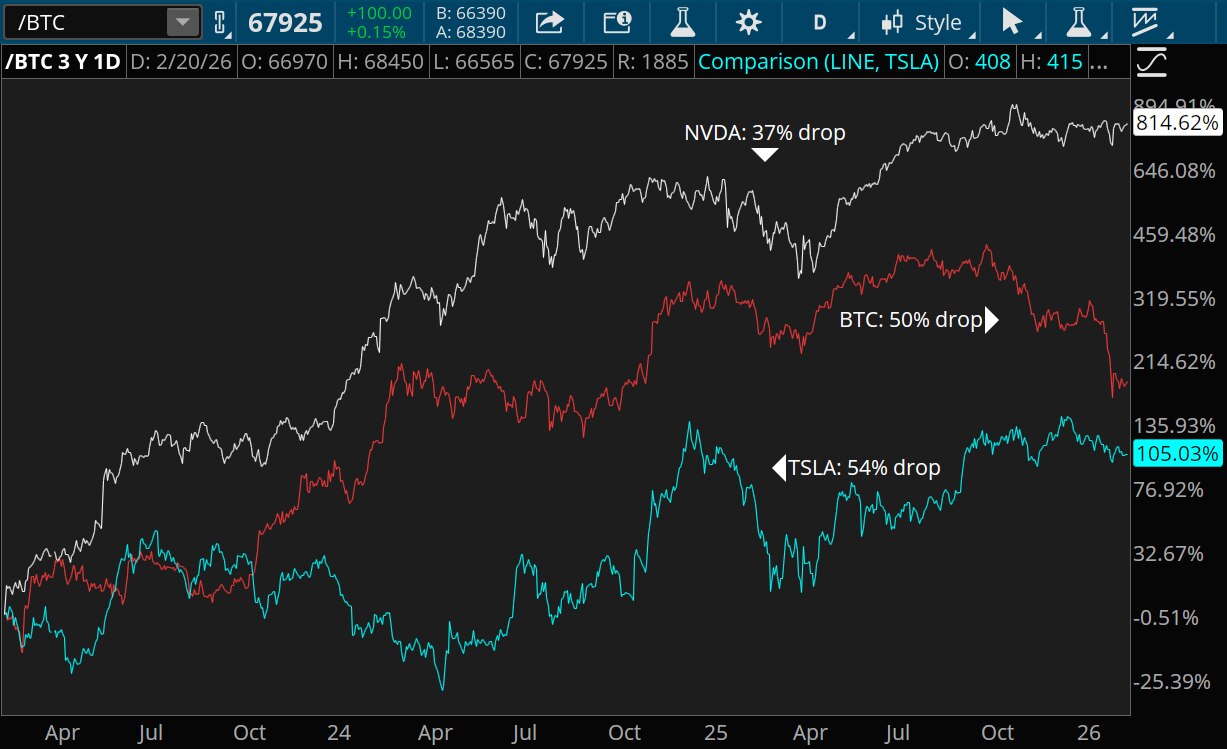
As the chart below illustrates, zooming out to three years (February 2023 to February 2026) captures any declines that stretch across calendar years. It shows that bitcoin's biggest drawdown totaled 50%, which was topped by TSLA's 54%. NVDA's biggest drawdown reached 37%.
Data sources: CME Group, Nasdaq. Chart source: thinkorswim® platform.
For illustrative purposes only. Past performance is no guarantee of future results.
Both TSLA and NVDA posted higher HV ratings and higher ATR/P across that three-year window. TSLA clearly outpaced bitcoin in terms of volatility, and one could argue that NVDA did too, if only narrowly. NVDA showed slightly higher HV and ATR/P numbers than bitcoin, but its maximum drawdown didn't punish investors quite like bitcoin did.
Five-year horizon
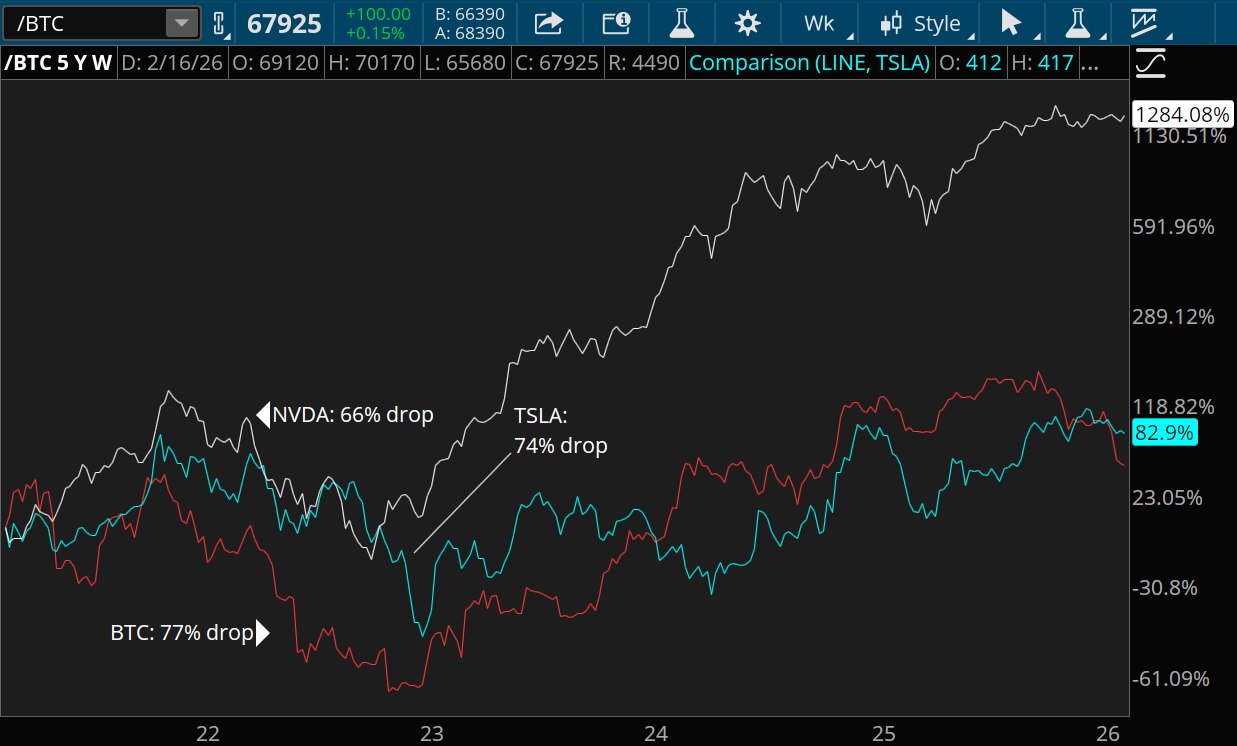
Zooming out to a five-year view tells a somewhat different story. All three assets sold off sharply during the 2022 equities bear market, with bitcoin sinking the deepest—77% from peak to trough. That compares with 74% for TSLA and 66% for NVDA.
Data sources: CME Group, Nasdaq. Chart source: thinkorswim platform.
For illustrative purposes only. Past performance is no guarantee of future results.
Still, TSLA's HV rating and ATR/P again exceeded those of bitcoin and NVDA in that five-year period. And with TSLA experiencing only a slightly shallower maximum drawdown than bitcoin, the data indicates that TSLA matched or even exceeded bitcoin's volatility during that time period.
Bitcoin, silver, and gold
In late 2025 and early 2026, bitcoin investors endured the biggest drawdown in several years. At the same time, Gold (/GL) and Silver (/SL) futures have soared to record highs, though not without hitting some speedbumps along the way. Meanwhile, bitcoin has fallen by half.
Though bitcoin dropped further from peak to trough than silver or gold in this period, silver likely cost traders at least as many sleepless nights. Silver's higher HV and ATR/P show that silver's daily moves were far bigger and bumpier than bitcoin's. Meanwhile, gold has shown far less volatility, marching higher without too many hiccups.
Bitcoin vs. ether
Price action in ether, the second-largest cryptocurrency by market cap, has also calmed a bit. Ether still trades with more volatility and bigger drawdowns than bitcoin. But while both are less volatile than previously, ether—which hasn't gained the same level of mainstream acceptance as bitcoin—has become significantly more volatile relative to bitcoin. (Altcoins such as ether are widely used as higher-volatility plays on bitcoin's price movements.)
The ratio of ether's HV to bitcoin's widened from 1.32 in 2021 to 1.78 in 2025, while the ratio of ether's and bitcoin's ATR/P widened from 1.26 to 1.72. The difference in the maximum drawdown also widened, from 1.08 to 1.87.
Bottom line
By two of the most common gauges, bitcoin's price volatility fell by roughly half from 2021 through 2025, as the world's largest crypto coin by market cap gained broader acceptance as a financial asset. While it's still capable of stomach-churning moves, whether in a single day or over months, it's certainly not alone on the volatility front.